Gas Liquefaction
www.GasLiquefaction.com


This Ad Space Available

info@GasLiquefaction.com

Strategic Competitive Advantage 
New Clients  *  Greater Market Share  *  Increased Revenues

For more information, call/email:

info@GasLiquefaction.com


Gas Liquefaction
www.GasLiquefaction.com


What is Gas Liquefaction?

Gas Liquefaction is the process in which natural gas is converted from the gaseous to the liquid phase. At the end of the Gas Liquefaction process, the product is referred to as "Liquefied Natural Gas" or "LNG." Gas Liquefaction is also called "Natural Gas To Liquid."


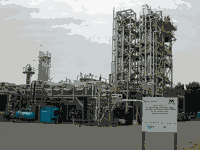
Gas Liquefaction Plant
Gas Liquefaction plant

_____________________________________________________

Stranded Gas Solutions


Our "Integrated" CHP Systems (Cogeneration and Trigeneration) Plants 
Have Very  High Efficiencies, Low Fuel Costs & Low Emissions

The Effective Heat Rate is Approximately 
4100 btu/kW & System Efficiency is 92% Plant.

The CHP System below is Rated at 900 kW and Features:
(2) Natural Gas Engines @ 450 kW each on one Skid with Optional 
Selective Catalytic Reduction
system that removes Nitrogen Oxides to "non-detect."


Our CHP Systems may be the best solution for your "stranded gas" resources.


_______________________________________________________


GreatSkin.com


____________________________________________________

What is an Amine Plant?

Amine plants are used for "gas sweetening" in the midstream oil and gas sector known as "gas processing." 

Amine plants provide H2S removal as well as CO2 removal from natural gas and liquid hydrocarbons. The process involves both absorption and chemical reactions.


What is an Amine Unit?

Amine units, also referred to as amine plants, are used for "gas sweetening" in the midstream oil and gas sector known as "gas processing."

Amine units provide H2S removal as well as CO2 removal from natural gas and liquid hydrocarbons. The process involves both absorption and chemical reactions.


What is Amine?

Amine, is the shortened form of " Mono Ethanol Amine" or MEA.  MEA removes H2S or acid gases through a chemical reaction with hydrogen sulfide or carbon dioxide which forms a salt compound (see Gas Sweetening diagram below). 

When the MEA has absorbed the H2S ( and carbon dioxide) it is referred to as " rich" MEA. 

When the acid gases have been removed from the mono ethanol amine it's called lean MEA.


What is "Amine Sweetening"?

Amine sweetening, also referred to as "amine gas treating," "gas sweetening" and "acid gas removal," is the natural gas treating process that uses aqueous solutions of various alkylamines ("amines") for H2S removal, or removing hydrogen sulfide (H2S) and carbon dioxide (CO2) from natural gas and other gas stream.  

Amine sweetening - via "amine plants," are found at gas processing plants and petrochemical plants. 

The term "amine sweetening" and "gas sweetening" are used in  hydrogen sulfide and/or mercaptans are commonly referred to as gas sweetening processes because they result in products which no longer have the sour, foul odors of mercaptans and hydrogen sulfide.

There following are the commonly used amines in natural gas treating:

Monoethanolamine (MEA)
Diethanolamine (DEA)
Methyldiethanolamine (MDEA)
Diisopropylamine (DIPA)
Aminoethoxyethanol (Diglycolamine®) (DGA®)

The most commonly used amines in industrial plants are the alkanolamines MEA, DEA, and MDEA.


BTEX Removal?

BTEX removal, as utilized in the natural gas treating and natural gas industry, is the process of removing benzene, toluene, ethylbenzene, and xylene from the natural gas stream and upgrading the natural gas to "pipeline quality gas."


What is BTEX?

BTEX, as defined by the Environmental Protection Agency (EPA), is the term used for benzene, toluene, ethylbenzene, and xylene which, as a group, are also referred to as "
volatile organic compounds," and normally found in petroleum products, including gasoline and diesel fuel.


What is
Desiccant Dehydration?

Desiccant Dehydration is a "natural gas treating" technology similar in the end result as other "gas processing" technologies including gas dehydration or glycol dehydration, with the exception that Desiccant Dehydration does not use amines.  Desiccant Dehydration uses "adsorption" technology to "dry" the natural gas.

Desiccant Dehydration using the adsorption typically consists of two (or more) adsorption towers. Each of these adsorption towers alternate between cycles wherein one tower is actively removing water/moisture from the gas stream, while the other adsorption tower is being "re-generated." Each of these adsorption towers are filled with a "desiccant" that can adsorb a limited amount of water and therefore require re-generation, typically by heat.

Standard desiccants include activated alumina or a granular silica gel material.

In the Desiccant Dehydration process, wet natural gas enters the adsorption towers, from the top and the wet natural gas flows down through the desiccant material, to the bottom. of the adsorption tower. As the wet natural gas passes around the desiccant material, water is separated from the natural gas which is "adsorbed" on the surface of these desiccant particles. By the time the natural gas reaches the bottom of the adsorption tower, over 98% of the water is adsorbed onto the desiccant material, leaving the dry gas to exit the bottom of the adsorption tower. After the desiccant in the active adsorption tower has adsorbed all the water/moisture it can, and reaches capacity, that active adsorption tower is shut down, and an adjacent adsorption tower then activates. During this time, the adsorption tower that has been shut down is "re-generated" and the water/moisture that was adsorbed by the desiccant is heated that vaporizes the water molecules, thereby "recharging" the desiccant and making it ready for use, when the adjacent adsorption tower has completed its cycle.


What is
Gas Dehydration?

Gas dehydration is used in the production and processing of natural gas by using either a liquid desiccant (or a dry desiccant in desiccant dehydration) that removes water from natural gas and natural gas liquids (NGL) in the natural gas treating process. This also makes the gas "pipeline quality gas" which can then be sold to a natural gas pipeline company.


What is a Gas Fractionation Plant?

A gas fractionation plant is a facility that separates mixtures of light hydrocarbons into individual, or industrially pure, substances. Gas fractionation plants are an integral part of gasoline plants, gas processing plant, gas refineries, and chemical and petrochemical processing plants. The raw materials of gas fractionation plants are composed mainly of hydrocarbons containing one to eight carbon atoms per molecule. The separation process at the gas fractionation plant of the hydrocarbon mixtures is performed by fractional distillation in "column distillers."

The process for separating natural gasoline in a gas fractionation plant includes preheating of the natural gasoline in a heat exchanger and feeding it to a "propane column."  The propane vapors are next "condensed" in a condenser-cooler which then flows to a a reflux vessel where the propane vapors exit from the top part of the column. Some of the propane is returned to the top of the column as a "reflux" and the excess propane is drawn off in the form of a finished product. 

After preheating, the liquid from the bottom of the column is fed for further separation by the same method into the next column, where a mixture of butanes is separated from the liquid in the form of overflow, and the gasolines exit from the lower part of the column.  The separation of butanes into isobutane and normal butane, as well as gasoline into isopentane, normal pentane and hexanes, continues in the same type process. approximate pure-substance content after processing of natural gasoline is approximately:

propane 96%
isobutane 95% 
normal butane 96% 
isopentane 95% 
gasoline 74%


Picture of a gas processing and fractionation plant which includes:  propane column, stabilization column, 
 isobutane column, condenser-coolers, preheaters for bottom of column, heat exchangers and coolers


Improvements in the technological system of fractionation plants are designed to reduce capital expenditures and power costs and to automate monitoring and control systems by means of electronic computers and by the installation of chromatographic product quality analyzers on flow lines.


What is
Gas Gathering?

Gas Gathering systems are the physical facilities that accumulate and transport natural gas from a well to an acceptance point of a transportation pipeline are called a gas gathering system.

Gas Gathering lines are small-diameter pipelines move natural gas from the wellhead to the gas processing plant or to an interconnection with a larger mainline pipeline. Transporting natural gas from the wellhead to the final customer involves several physical transfers of custody and multiple processing steps. A natural gas pipeline system begins at the natural gas producing well or field.  Once the gas leaves the producing well, a gas gathering system directs the flow either to a gas processing plant or directly to the mainline transmission grid, depending upon the initial quality of the wellhead product. 

The processing plant produces pipeline-quality natural gas.  This gas is then transported by pipeline to consumers or is put into underground storage for future use.  Storage helps to maintain pipeline system operational integrity and/or to meet customer requirements during peak-usage periods. 

Transporting natural gas from wellhead to market involves a series of processes and an array of physical facilities. Among these are:


What is Gas Processing?

Natural Gas Processing plants separate the various hydrocarbons and natural gas liquids from the pure natural gas (methane or CH4) to produce what is known as 'pipeline quality' natural gas. Natural gas pipeline companies have requirements on natural gas they buy from producers which is why the natural gas processing plants are located where they are, and why they separate the ethane, propane, butane, and pentanes from the methane. Natural gas liquids or NGLs include ethane, propane, butane, iso-butane, and natural gasoline.


What is a
Gas Processing Plant?

The principal service provided by a gas processing plant to the natural gas mainline transmission network is that it produces pipeline quality natural gas. Natural gas mainline transmission systems are designed to operate within certain tolerances. Natural gas entering the system that is not within certain specific gravities, pressures, Btu content range, or water content level will cause operational problems, pipeline deterioration, or even cause pipeline rupture.

Gas processing plants are also facilities designed to recover natural gas liquids from a stream of natural gas that may or may not have passed through lease separators and/or field separation facilities. These facilities also control the quality of the natural gas to be marketed. Several types of gas processing plants, employing various techniques and technologies to extract contaminants and natural gas liquids, are used to produce pipeline quality "dry" gas. At many processing plants the primary objective is the production of dry gas (demethanizing). Any remaining natural gas liquids extraction stream is directed to a separate plant to undergo what is referred to as a "gas fractionation" process.

But a number of natural gas processing plants do include these gas fractionation plants  where saturated hydrocarbons are removed from natural gas and separated into distinct parts, or "fractions," such as propane, butane, and ethane. Essentially, natural gas is methane, a colorless, odorless, flammable hydrocarbon gas (CH4). Also present in natural gas production, especially that in association with oil production, are a number of petroleum gases. They include (in addition to ethane, propane and butane) ethylene, propylene, butylene, isobutane, and isobutylene. They are derived from crude oil refining or natural gas fractionation and are liquefied through pressurization.


What is Gas Sweetening?

Sulfur exists in natural gas and is known as hydrogen sulfide (H2S). Natural gas is usually considered "sour" if hydrogen sulfides content exceeds 5.7 milligrams of H2S per cubic meter of natural gas. The process hydrogen sulfide removal from sour gas is commonly referred to as "gas sweetening."


http://www.gasprocessing.net/process.jpg

Diagram of the Gas Sweetening Process


The primary process for sweetening "sour" natural gas ("sour" natural gas contains H2S or hydrogen sulfides) is quite similar to the processes of glycol dehydration and NGL absorption. In this case, however, amine solutions are used to remove the hydrogen sulfide. This process is known simply as the 'amine process', or alternatively as the Girdler process, and is used in 95 percent of U.S. gas sweetening operations. The sour gas is run through a tower, which contains the amine solution. This solution has an affinity for sulfur, and absorbs it much like glycol absorbing water. There are two principle amine solutions used, monoethanolamine (MEA) and diethanolamine (DEA). Either of these compounds, in liquid form, will absorb sulfur compounds from natural gas as it passes through. The effluent gas is virtually free of sulfur compounds, and thus loses its sour gas status. Like the process for NGL extraction and glycol dehydration, the amine solution used can be regenerated (that is, the absorbed sulfur is removed), allowing it to be reused to treat more sour gas.

Although most sour gas sweetening involves the amine absorption process, it is also possible to use solid desiccants like iron sponges to remove the sulfide and carbon dioxide.

Sulfur can be sold and used if reduced to its elemental form. Elemental sulfur is a bright yellow powder like material, and can often be seen in large piles near gas treatment plants, as is shown. In order to recover elemental sulfur from the gas processing plant, the sulfur containing discharge from a gas sweetening process must be further treated. One sulfur recovery process is called the "Claus" process, and involves the use of thermal and catalytic reactions to extract the elemental sulfur from the hydrogen sulfide solution.

Some of the above information from www.NaturalGas.org with our thanks.


What is
Glycol Dehydration?

Glycol dehydration is used in the production and processing of natural gas by using a liquid desiccant that removes water from natural gas and natural gas liquids (NGL).

Various types of glycols are used in this process including;

TEG is the most commonly used glycol in the natural gas industry.


What is
H2S Removal?

H2S, or Hydrogen Sulfide, is a hazardous and corrosive element found in oil and natural gas which needs to be removed from the hydrocarbon before the oil or natural gas can be sold. The hydrogen sulfides are usually removed in a mid-stream gas processing facility by either iron sponges or amine plants.


What Are Hazardous Air Pollutants?

Hazardous Air Pollutants or "HAPs" are generally defined as those pollutants that are known or suspected to cause serious health problems. Section 112(b) of the Clean Air Act currently identifies a list of 188 pollutants as HAPs.


What is a
Heater Treater?

A "Heater Treater" is used in the oil and gas production process and is used to removes water and gas from the produced oil - and to improve its quality for sale into a crude oil pipeline or for other transport. A heater treater typically combines the following components inside the heater treater: a heater, free-water knockout, and oil and gas separator.


What is a "JT Plant?"

A JT Plant, or "Joule-Thomson" plant operates as a gas processing plant in that the JT Plant operates through a natural gas pressure differential causing the temperature to fall significantly, thereby making the natural gas liquids (propane, butane, and natural gasoline) within the natural gas stream, to "condense" and fall out of the natural gas stream.

The purpose of a JT Plant is to condense the heavier natural gas liquids from the natural gas stream to meet that specific natural gas pipeline's "pipeline quality gas" specifications thereby making the natural gas saleable to downstream end-users/customers. The natural gas liquids that are produced from the JT plant are stored in tanks for eventual sale as propane, butane and natural gasoline.


What is Liquefied Natural Gas?


Liquefied Natural Gas, or LNG, is natural gas (methane or CH4) that is cooled to - 260 degrees F. (below zero). At this temperature, natural gas turns into a liquid (liquefied natural gas) making it very economical to ship large amounts of energy in a relatively small space.

When natural gas has been liquefied, the natural gas that was once a "gas" now takes up to 600 times LESS as a liquid, as when it was in its previous gas state.

Because Liquefied Natural Gas is still natural gas, its carbon emissions as well much lower as compared to other fossil fuels, such as coal, diesel or oil.

Liquefied Natural Gas is colorless, odorless, colorless, non-corrosive and non-toxic. It weighs less than half the equivalent amount that water does.

Liquefied Natural Gas achieves a higher reduction in volume than compressed natural gas (CNG) so that the energy density of Liquefied Natural Gas is 2.4 times that of compressed natural gas or 60% of that of diesel fuel.  This makes Liquefied Natural Gas a highly cost-effective fuel to transport over long distances where pipelines do not exist.  Cryogenic tanks and LNG ships transport the LNG around the world on oceans and cryogenic tanks transport the LNG on trains and 18-wheelers.  Think of cryogenic tanks like an insulated thermos bottle as the LNG must be kept at - 260 degrees F. (below zero) to remain in its liquid state.

Liquefied Natural Gas is used as any fuel may be used, as well as transporting natural gas to markets, where it is then re-gasified and distributed in natural gas pipelines. 


What is LNG Liquefaction


LNG Liquefaction is a process that refrigerates Natural Gas until it is condensed into a liquid at close to atmospheric pressure (maximum transport pressure set at around 25 kPa/3.6 psi) by the natural gas to approximately −162 °C (−260 °F) which reduces its volume to 1/600th or its original volume for ease of transportation. 

Liquefied Natural Gas or simply "LNG" is natural gas which is primarily methane or CH4 that has been liquefied to reduce its volume. As previously stated, LNG is colorless, odorless, non-toxic and non-corrosive. LNG hazards include flammability, freezing and asphyxia.

The LNG Liquefaction takes place at an LNG terminal, typically located at an ocean port where one or more natural gas pipelines deliver natural gas.  The natural gas has had the contaminants removed by gas processing and purification, which removes, condensates such as water, dust, helium, mud, oil, CO2, H2S and mercury.  The natural gas is then cooled down in stages until it is finally liquefied at -160 degrees C.   The Liquefied Natural Gas is stored in cryogenic storage tanks and loaded onto an LNG ship and shipped.


Gas Liquefaction Plant
LNG Liquefaction plant


What are Midstream Assets?

Midstream Assets include those assets and services that link the supply side of the value chain within the industry, to the demand side for for these energy commodities.

The Midstream Assets and the Midstream Oil and Gas sector is the bridge between the energy producers and the energy end-users and - therefore, can only be as strong as the weakest link or bridge within the midstream oil and gas sector. 

Typical midstream assets include;  


What is the "Midtream Oil and Gas" sector?

The "midstream oil and gas" sector receives the oil and natural gas from the upstream oil and natural gas sector and provides initial gas processing, terminalling and storage, and transports the oil and natural gas and natural gas liquids for further natural gas treating and desulfurization "downstream." The natural gas may be processed or treated in the midstream sector through gas processing or natural gas treating facilities for producing pipeline quality gas for direct sale to a interstate or intrastate natural gas pipeline, and may bypass the downstream oil and natural gas sector entirely.

The downstream sector usually refers to crude oil refineries and the selling and distribution of natural gas and products derived from crude oil.  These products include Liquefied Petroleum Gas or "LPG," gasoline, jet fuel, diesel fuel, and other fuel oils, as well as asphalt and petroleum coke.


What is
Natural Gas Liquefaction?

Natural Gas Liquefaction is the process in which natural gas is converted from the gaseous to the liquid phase. At the end of the Natural Gas Liquefaction process, the product is referred to as "Liquefied Natural Gas" or "LNG."

Natural Gas Liquefaction is also called "Natural Gas To Liquid."

Gas Liquefaction Plant
Natural Gas Liquefaction plant


What are Natural Gas Liquids?

Natural Gas Liquids or "NGL" are those hydrocarbons in natural gas that are separated from the gas as liquids through the process of absorption, condensation, adsorption, or other methods in gas processing or cycling plants. 

Natural Gas Liquids include ethane, propane, butane, iso-butane, and pentane or natural gasoline. These NGLs are sold separately and have a number of different uses which include; enhanced oil recovery in oil wells, providing raw materials for oil refineries or petrochemical plants and as sources of liquid fuel such as propane.

Typically, these liquids consist of propane and heavier hydrocarbons and are commonly referred to as lease condensate, natural gasoline, and liquefied petroleum gas.


What is Natural Gas Storage?

There are periods of time in peak periods of natural gas use, that a natural gas company (pipeline or LDC) may not be able to keep up with these peak demand periods. Natural gas storage is a way to help provide for the natural gas reserves or natural gas supplies that are needed during these peak demand periods. Having strategically-located natural gas storage capabilities can assist natural gas pipelines or LDCs provide the natural gas supply when their customers demand.

America's need for natural gas continues to grow.

Recent governments studies conclude that demand for clean-burning natural gas has continued to rise. In the last 20 years, natural gas consumption has risen nearly 25%.

The Energy Information Administration (EIA) estimates there are over 2,100 Trillion cubic feet (Tcf) of "technically recoverable natural gas" reserves in the United States, as reported in the EIA's 2010 Annual Energy Outlook. In 2009, the United States used just over 22 Trillion cubic feet of natural gas, making the U.S. one of the global leaders in natural gas consumption. This means the U.S. has enough natural gas supply to last about 100 years.

With greater demand comes greater need to be able to store natural gas. In the past 20 years, natural gas storage has increased less than 5%. This creates a serious constraint that can impact our nation by failing to keep up with natural gas supply and demand. Existing natural gas storage facilities will not be able to keep up with the demand for natural gas during increasingly greater periods of increasing demand, which could cost all consumers of natural gas billions of dollars.

More Natural Gas Storage is Needed

There is a critical need for new high-volume natural gas storage facilities to meet the escalating demand for natural gas which will provide predictability of natural gas supply and reduce or eliminate volatility of natural gas prices during peak periods. Natural gas storage "balance" the load - or supply and demand requirements of all natural gas consumers and provides the "cushion" needed for large supplies of natural gas to serve all consumers during periods of peak demand.

Natural gas storage can take place in a number of underground natural gas facilities. From the time the natural gas is produced, it may be stored temporarily in underground natural gas storage facilities that may be one or more of the following; depleted oil or natural gas fields/reservoirs, salt dome caverns/salt dome storage or former aquifers.

Most of the natural gas storage in the U.S. takes place in naturally-occurring natural gas or oil reservoirs that have been depleted through production. An underground gas storage facility must contain enough “base gas” or “cushion gas” that provides adequate pressure to re-produce and extract the natural gas.


What is Natural Gas Treating?

As natural gas is produced from either a natural gas well, or from an oilwell which contains "associated gas," the natural gas must be treated or processed before it can be sold/injected as "pipeline quality gas" and then be used at a home or business as a fuel.

Natural gas treating or processing, takes place at gas processing plants to remove the impurities and other hydrocarbons other than the methane itself, or CH4.

The by-products and impurities of natural gas that must be treated or processed include; ethane, propane, butane, isobutane, pentane, isopentane and higher molecular weight hydrocarbons, as well as H2S or elemental sulfur, carbon dioxide (CO2), water vapor and sometimes helium and nitrogen.


What is "NGL Fractionation"?

NGL, or natural gas liquids fractionation plants purpose is to separate the mixed natural gas liquids stream into separated products. These natural gas liquids that are separated by heat at NGL Fractionation plants include; ethane, propane, normal butane, isobutane and natural gasoline.


What is NGL Recovery?

Toward the end of the gas processing process and natural gas treating process, wherein the "raw" natural gas (methane or CH4) is readied for sale as "pipeline quality gas," the recovery of the valuable natural gas liquids (NGL) takes place. In many gas processing facilities, a cryogenic plant - which provides low-temperature distillation that recovers the natural gas liquids. The residue gas from the NGL recovery process, is the purified pipeline quality gas that is sold via pipeline and sent so end-users such as LDCs (local distribution companies - or natural gas utility) for distribution via natural gas mains in their cities and markets.

Other NGL recovery methods include an NGL fractionation "train" which typically consists of three distillation towers in a series. The series occurs in the following order:

1. deethanizer
2. depropanizer
3. debutanizer.

The overhead product from the deethanizer is ethane - after which the bottoms flow to the depropanizer. The overhead product from the depropanizer is propane and the bottoms then flow to the debutanizer. The overhead product from the debutanizer is a mixture of normal butane and iso-butane. The bottoms products are a C5+ mixture. Most cryogenic plants, however, do not include fractionation due to economic reasons. Therefore the NGL stream is then transported as a mixed product to separate, standalone fractionation plants that are located near refineries or chemical plants that need these NGLs feedstock.


What is
"Pipeline Quality Gas"?

"Pipeline Quality Gas," is the purified and processed form of natural gas (CH4, natural gas or methane) that has had impurities, natural gas liquids and contaminants such as H2S (hydrogen sulfide) removed to meet "pipeline quality" requirements. This makes the natural gas useable to residential, commercial and industrial customers.

Pipeline Quality Gas is also used in the biogas and biomethane industry. In this case, "raw" biogas that is produced from Anaerobic Digesters and Landfill Gas To Energy projects cannot be sold to natural gas pipelines or used in internal combustion engines due to the high number of contaminants, impurities and other chemicals in the biogas.

Raw biogas, in order to become Biomethane or Pipeline Quality Gas, must for from "Biogas to Biomethane" wherein the impurities and contaminants of the biogas are removed. This process of biogas purification to biomethane is also called "Gas Sweetening." The impurities and contaminants of biogas that need to be removed to then have Biomethane or Pipeline Quality Gas include; carbon dioxide (CO2), water, hydrogen sulfide (H2S) and Siloxane. Some of the Biogas to Biomethane technologies include; iron sponge, water scrubbing, membrane separation, pressure swing adsorption (PSA), and mixing with higher quality gases. 


What is "Stranded Gas?"

Stranded Gas, also referred to as "stranded natural gas," refers to natural gas that has been discovered but has not, or will not be developed due to their location or the economics of getting the natural gas delivered to the marketplace.

Did you know that approximately 40% of the world's available natural gas reserves are classified as stranded gas?

The Department of Energy estimates that there are 3,000 Tcf of stranded gas world-wide!

Stranded gas may be stranded - or become stranded in the future, for several reasons;

* the nearest natural gas pipeline may be too far from the well in terms of the economics of running a new pipeline.
* the volume of natural gas produced may not be of sufficient quantities for the natural gas pipeline company.
* the quality of the natural gas produced may not meet the "
pipeline quality gas" specifications of the natural gas pipeline
company.
* the amount of natural gas produced from the well may decline over the years to amounts that do not meet the natural gas
pipeline's minimum amounts among other reasons.

We provide solutions for oil and gas companies with stranded gas.

One of our solutions for oil and gas companies with stranded gas is to use the stranded gas as fuel that generates clean electricity with one of our "gas to power" solutions using gas turbine generators. Our affiliated company manufactures gas turbine gensets For as little as $785/kW (plus shipping costs and any related set-up costs) you could be generating revenues with one of our gas turbine generators!

Natural gas pipelines have transported natural gas safely, reliably, and economically to the marketplace whenever large reservoirs of natural gas are found in locations where there were existing pipelines. Even for new natural gas fields, where there are large reservoirs and supplies of natural gas, pipelines were laid to transport the natural gas to markets. However, natural gas supplies from easy to find, and easy to produce fields have been on the decline. This leaves the "stranded gas" from the fields that have not been developed due to the economics, location, or the supply was not large enough. Stranded gas wells and reservoirs are becoming increasingly attractive opportunities as we can make the stranded gas a new profit center for your company.

We can help your company turn unproductive, zero revenue stranded gas assets into economic cash flows and a new source or revenues. Stranded gas wells with a nearby electric transmission line with a minimum production of approximately 70,000 cubic feet of natural gas per day - can become a new profit center with our assistance!

Do you have a minimum of 400 mcf/day from your stranded gas well? If yes, we can install an affiliated company's gas turbine generator and generate about 1.0 MW of electricity, 24 x 7 x 365.

We can take stranded gas gas wells that have been plugged & abandoned years ago, and make them productive and profitable by taking the stranded gas and placing one or more of our power plants at or near the site - and using the stranded gas as the fuel to generate power, selling the electricity to the electric grid - thereby creating a new profit center from shut-in wells. Shut-in natural gas wells can be made productive, with new revenues from generating our gas to power solutions. Or, if there is a nearby commercial or industrial operation that needs hot water or steam, we can develop a cogeneration power plant as well, selling them the thermal energy and the power to the electric grid.

It's much easier to transport electrons long distances, than it is to transport natural gas long distances.

Alternatively, depending on the location, we may be able to place LNG equipment near Stranded Gas wells and convert the natural gas to Liquefied Natural Gas, and then transport the LNG to a nearby market.

We provide Flare Gas Recovery, Vapor Recovery Units and "Stranded Gas" solutions. We offer turnkey, "vendor-neutral" power/energy project development products and services. Unlike most companies, we are equipment supplier/vendor neutral. This means we help our clients select the best equipment for their specific application. This approach provides our customers with superior performance, decreased operating expenses and increased return on investment.


What is "Upstream Oil and Gas"?

The oil and natural gas industry is divided into three major segments:

The Upstream Oil and Gas segment is a term that refers to the searching, drilling and production of crude oil and natural gas. The Upstream Oil and Gas segment is also known as the "exploration and production" or "E&P" segment.

The Upstream Oil and Gas segment includes; exploring for potential underground (or underwater) oil and natural gas fields (or reservoirs), drilling of exploratory wells, and operating/producing the oil and natural gas wells that "pay" with crude oil and/or natural gas.


What is a
Vapor Recovery Unit?

A vapor recovery unit is a device that captures or recovers valuable volatile organic compounds and other rich gas streams that may otherwise be a significant environmental pollutant or hazardous air pollutant. A well designed vapor recovery unit can pay for itself in less than 3 years and simultaneously mitigate a company's exposure to environmental liabilities.


About Us:

We provide natural gas engineering and midstream oil and gas services which are led by an independent natural gas engineering firm that assists our company with acquisitions and project development services in the following areas;

natural gas plays.

Our engineering team provides complete natural gas engineering services from the wellhead to the burner-tip with a focus in the midstream sector. Our midstream oil and gas engineering and project development development services include;

Our work is performed on a strict adherence to "vendor-neutrality" and seek to maximize our client's "triple bottom line" returns: people, planet and profits.

To receive a preliminary, no obligation consult, email us a summary or overview of your project, including the following basic information:

and your company's specific goals and objectives.

____________________________________________________


Drill Baby Drill!
www.DrillBabyDrill.com


No Foreign Oil
www.NoForeignOil.com

No Foreign Oil

____________________________________________________

“spending hundreds and hundreds and hundreds of billions of dollars every year for oil, much of it from the Middle East, is just about the single stupidest thing that modern society could possibly do. It’s very difficult to think of anything more idiotic than that.”

~ R. James Woolsey, Jr., former Director of the CIA


Support Domestic Oil and Gas Production!

___________________________________________________


What is a "Durable Competitive Advantage?"

A durable competitive advantage is also referred to as a "strategic competitive advantage," however similar, they are different. The two differ in that a company with a durable competitive advantage can go on indefinitely. Companies that have a durable competitive advantage include Coca-Cola and Hershey's. The term "durable competitive advantage" has been popularized by "the Oracle of Omaha," Warren Buffet the Founder and Chairman of Berkshire Hathaway as the single-most important asset a company must before his company will make the investment or acquisition.


What is a Strategic Competitive Advantage?

A company with a strategic competitive advantage consistently outperforms their competition through its strategic competitive advantage(s) which is that company's unique value proposition wherein it produces better products or services than anyone else.

___________________________________________________

Advertisers and Links:


Amine Plants
www.
AminePlants.com


Amine Sweetening
www.
AmineSweetening.com


Amine Units
www.
AmineUnits.com


Blowout Preventer - BOP
www.BlowoutPreventer.net


Blowout Preventers - BOP
www.BlowoutPreventers.net


Blowout Prevention
www.
BlowoutPrevention.com


BOP Stack

www.
BOPstack.com


BTEX Removal

www.
BTEXremoval.com


Carbon Emissions
www.
CarbonEmissions.com


Casinghead Gas
www.
CasingheadGas.com


Cogeneration
www.
Cogeneration.net


Compressed Natural Gas - CNG
www.CompressedNaturalGas.net


Crude Oil Storage
www.CrudeOilStorage.com


Cryogenic Plant

www.
CryogenicPlant.com


Desiccant Dehydration
www.DesiccantDehydration.com


Domestic Oil and Gas
www.DomesticOilAndGas.com


Drilling and Completion
www.DrillingAndCompletion.com


Enhanced Oil Recovery
www.EnhancedOilRecovery.com


Exploration and Development
www.ExplorationAndDevelopment.com


Exploration and Production
www.ExplorationAndProduction.net


Field Compression
www.FieldCompression.com


Fractionation Plant
www.FractionationPlant.com


Gas Compression
www.GasCompression.net


Gas Compressors
www.GasCompressors.net


Gas Compressor Rental
www.GasCompressorRental.com


Gas Compressor Sales
www.GasCompressorSales.com


Gas Dehydration
www.GasDehydration.com


Gas Fractionation
www.GasFractionation.com


Gas Liquefaction
www.GasLiquefaction.com


Gas Processing
www.GasProcessing.net


Gas Reinjection
www.GasReinjection.com


Gas Sweetening
www.GasSweetening.com


Gas Well Blowout
www.GasWellBlowout.com


Gas Well Control
www.GasWellControl.com


Gathering and Processing
www.GatheringAndProcessing.com


Geothermal Power Plant
www.GeothermalPowerPlant.com


Glycol Dehydration
www.GlycolDehydration.com


Greenhouse Gas Emissions

www.
GreenhouseGasEmissions.com


Greenhouse Gas Reporting
www.
GreenhouseGasReporting.com


Hazardous Air Pollutants - HAP
www.HazardousAirPollutants.com


Heater Treater
www.HeaterTreater.com


H2S Removal
www.H2Sremoval.com


Joule Thomson
www.JouleThomson.com


JT Plant
www.JTplant.com


JT Plants
www.JTplants.com


Liquefied Natural Gas - LNG
www.LiquefiedNaturalGas.net


Liquefied Petroleum Gas - LPG
www.LiquefiedPetroleumGas.net


LNG Liquefaction
www.LNGliquefaction.com


Midstream Assets
www.MidstreamAssets.com


Midstream Oil and Gas
www.MidstreamOilAndGas.com


Natural Gas Assets
www.NaturalGasAssets.com


Natural Gas Conditioning
www.NaturalGasConditioning.com


Natural Gas Engineering
www.NaturalGasEngineering.net


Natural Gas Liquefaction
www.NaturalGasLiquefaction.com


Natural Gas Liquids - NGL
www.NaturalGasLiquids.net


Natural Gas Marketing
www.NaturalGasMarketing.net


Natural Gas Sales
www.NaturalGasSales.net


Natural Gas Storage
www.NaturalGasStorage.net


Natural Gas to Liquid
www.NaturalGasToLiquid.com


Natural Gas Treating
www.NaturalGasTreating.com


NGL Fractionation
www.NGLfractionation.com


NGL Recovery
www.NGLrecovery.com


Nitrogen Oxides
www.NitrogenOxides.com


Oil and Gas Well 
www.OilAndGasWell.com


Oil and Natural Gas 
www.OilAndNaturalGas.net


Oil Well Blowout
www.OilWellBlowout.com


Oil Well Control
www.OilWellControl.com


Organic Rankine Cycle - ORC
www.OrganicRankineCycle.com


Pipeline Compression
www.PipelineCompression.com


Pipeline Quality Gas
www.PipelineQualityGas.com


Rental Compression
www.RentalCompression.com


Salt Dome Storage
www.SaltDomeStorage.com


Snubbing Unit

www.
SnubbingUnit.com


Snubbing Units
www.
SnubbingUnits.com


Stranded Gas
www.
StrandedGas.com


Terminalling
www.Terminalling.com


Terminalling and Storage
www.TerminallingAndStorage.com


Upstream Oil and Gas
www.UpstreamOilAndGas.com


Vapor Recovery Unit - VRU
www.VaporRecoveryUnit.com


VOC Removal
www.VOCremoval.com


Waste Heat Recovery
www.WasteHeatRecovery.com


Wellhead Gas
www.
WellheadGas.com

___________________________________________________

Gas Liquefaction
www.GasLiquefaction.com

Gas Liquefaction

info@GasLiquefaction.com


ad, ads, advertising, online, online ad, online ads, online advertising, web, web site, web site advertising, website, marketing, URL, domain name, business development, market, marketing, increased market share, greater market share, strategic marketing, competitive advantage, new business, search, search engine, search engine optimization, SEO, oil well, oil and gas, oil and gas well, drilling rig, drill baby drill, no foreign oil, oil and gas drilling rig, natural gas, oil and natural gas, crude oil, crude oil storage, drilling and completion, upstream, upstream oil and gas, exploration, production, development, exploration and production, E&P, exploration and production, revenues, increased revenues, market share, increased sales, greater sales, investor, investors, investment, investments, accredited investor, royalty, oil and gas royalty, oil and gas royalties, oil and gas investor, oil and gas investment, top banner ad, this top banner ad space, top banner ad available


Copyright © 2003
All Rights Reserved